How to Watch a Rugby Match for the First Time
Watching a rugby match for the first time gets easier when you read referee signals, identify restarts, and follow one player’s role through the match.
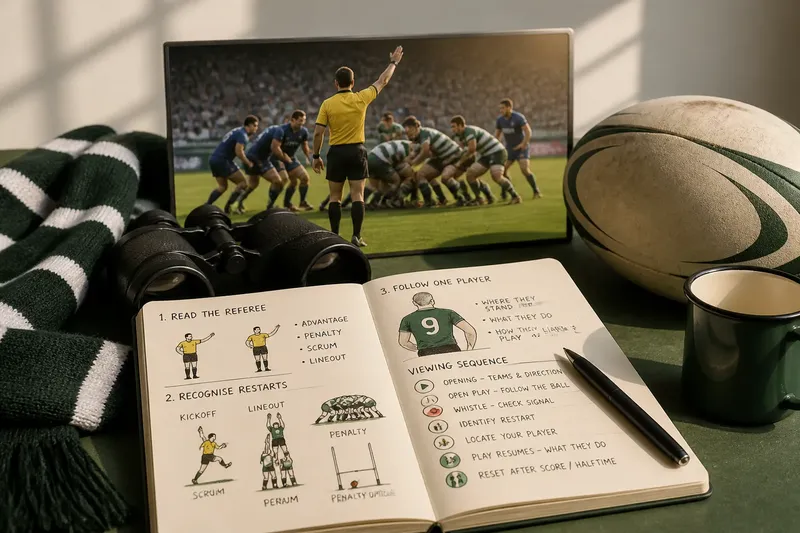
You settle into a seat as the ball skids out of a tackle, players gather around it, and the referee raises an arm. Watching a rugby match for the first time can feel like following several conversations at once. Start with three anchors: the referee’s signals, the way play resumes, and one player’s role.
You do not need to learn every law before kickoff. The aim is to connect what you see to what happens next. A short note on your phone or a folded program can help, but keep the match in view.
Set your viewing focus
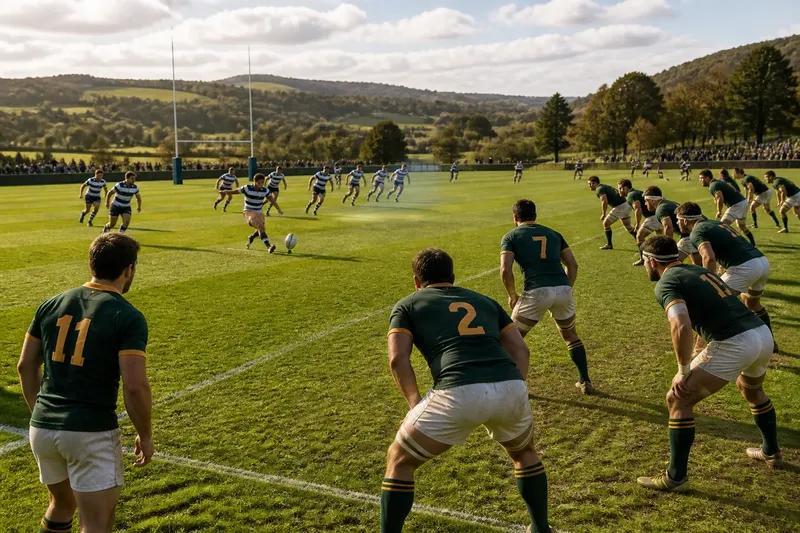
Before play begins, choose a side to follow and notice which way it is attacking. Teams change direction at halftime, so reset your bearings then. On television, the score graphic and camera angles can help; in the stands, team colors offer a visual anchor.
Pick a player whose position is easy to recognize. A scrum-half, often wearing number nine, usually works near the breakdown and moves the ball away from it. A fly-half, often number ten, tends to stand farther back as a passing or kicking option. A winger stays near a touchline, though the ball may not reach them often.
Choose the role that interests you rather than assuming one player will touch the ball most. Watching the same person before and after possession changes gives you a thread through the match.
Read referee signals
After a whistle, watch the referee before interpreting the players’ reactions. Appeals and quick movements can be hard to read; the signal and the restart usually provide clearer clues about what the decision means.
A raised arm held up can indicate advantage. In broad terms, advantage means play continues after an infringement so the non-offending team has a chance to benefit. Watch whether that team gains useful possession or territory. The referee may let play continue or return to the original infringement.
A referee’s direction can indicate which team has been awarded a restart or possession. Players forming two lines by the touchline often signal a lineout; a compact, bound formation suggests a scrum. After a penalty, a team may choose a kick at goal, a kick for territory, or a quick tap, subject to the laws and the circumstances of play.
You need not name every gesture right away. Pair the signal with the action that follows: who gets the restart, what shape the players form, and where play resumes.
Recognize rugby restarts
A restart is the method used to resume play after a score, a ball going out, or another stoppage. Identifying it helps you know where to look, but the precise restart depends on the laws, the reason play stopped, and the match context.
A kickoff starts each half and restarts play after a try or a successful conversion. A drop-out is used in certain other situations, such as when the ball is made dead in the in-goal area under specified circumstances. Rather than treating every kick as the same event, look at the referee’s signal and the players’ formation to understand which restart is taking place.
When the ball goes into touch, a lineout is a common restart, but it is not the only possibility. The team that kicked the ball, where the kick was taken, whether the ball bounced in the field of play, and the applicable law can affect who throws in or whether a lineout is awarded. If the referee indicates a lineout, watch the two lines beside the touchline and the throw between them; if the referee signals something else, follow that decision instead.
A scrum follows certain stoppages, including some handling errors and infringements. The forwards bind together, and the scrum-half feeds the ball in according to the laws. Instead of trying to judge technical details as a new viewer, notice which team emerges with possession and how the ball is moved away from the scrum.
After a penalty, a team may kick for territory, attempt a kick at goal, or take a quick tap and run. A kick to touch can lead to a lineout if the laws award one in that situation; a quick tap can restart play before defenders have settled. Watch the referee and the players’ choices to see which option is being taken.
Say the ball rolls over the touchline near halfway. The referee signals a lineout, and players gather beside the sideline. You can shift your attention there rather than follow a player who has stopped; then watch for the throw, the contest, and the team that comes away with the ball.
Track one player’s role
Once you recognize a few signals and restarts, return to your chosen player. A scrum-half often stays near the back of a ruck or scrum; a fly-half may wait behind the forwards; a winger may hold a wide position near the touchline. These are common patterns, not fixed locations.
When the player’s team attacks, ask what option they offer. A scrum-half may pass from a breakdown. A fly-half may distribute, run, or kick after receiving the ball. A winger may hold width, join the attacking line, or chase a kick. Their position before the ball arrives can make their role easier to see.
When their team defends, look at the space they are responsible for and how they respond to the attack. A fly-half may help organize the line, while a winger may watch for a kick behind the defenders. Players can switch positions or adapt to the play, so treat these as clues rather than fixed assignments.
Imagine you choose the scrum-half. At each breakdown, you look for where they stand, whether they collect the ball, and who receives their next pass. If you repeatedly see them connect close-in play with teammates farther out, you have identified one part of their job without memorizing every position.
Use a viewing sequence
At the opening whistle, identify the teams, their direction of attack, and your chosen player. During open play, follow the ball. At a stoppage, check the referee’s signal, identify the restart, and then locate your player again.
At kickoff, note which team receives the ball and where your chosen player is positioned.
At a whistle, look for the referee’s signal before guessing what the decision means.
As players prepare to resume, distinguish a scrum, lineout, penalty option, kickoff, or other restart from the formation and signal; if you cannot tell, watch for the referee’s next direction.
When play resumes, locate your chosen player and notice whether they pass, carry, kick, defend, or support; if they are out of view, follow the ball until the camera or action returns to them.
After halftime or a score, reset your sense of direction and check which team has the next restart.
It is not worth the effort to pause over every unfamiliar term or debate every close decision. If a call matters to your understanding, ask a companion during a break or make a note to check later. Trying to decode every law in real time can pull your attention away from the patterns you are learning to see.
Questions viewers ask?
Why does the referee let play continue after an infringement?
The referee may be playing advantage, giving the non-offending team a chance to benefit from continued play. Watch whether that team makes progress or retains possession; if not, the referee may bring play back to the original infringement.
Why do players form different groups after play stops?
The shape often hints at the restart: two lines by the sideline suggest a lineout, while a compact, bound formation suggests a scrum. Check the referee’s signal as well, because formations alone do not settle every decision.
Which player should a first-time viewer follow?
A scrum-half is a useful choice if you want to watch how the ball is moved away from breakdowns, while a winger is easy to spot near the touchline. A fly-half can suit you if you want to watch how close play connects to passing, running, and kicking options.
Does a player keep the same job throughout the match?
The broad role remains recognizable, but a player may move to cover space or respond to changing play. Follow their decisions and position rather than expecting them to stand in one place.
Keep the match thread
Watching a rugby match for the first time becomes more manageable when each clue answers a different question. The referee’s signal helps explain a stoppage, the restart shows how play resumes, and one player’s role gives you a recurring point of attention.
After the match, try to describe one sequence in plain language: what stopped play, what restart followed, and what your chosen player did next. That short account can also help you spot what remains unclear, such as why a particular kick out of touch led to a lineout or a different restart.