Why Rugby Restarts Are Built Around Contest
Rugby restarts turn a score into a contest. Learn how the kick, catch, and each side’s formation shape the first phase of play.
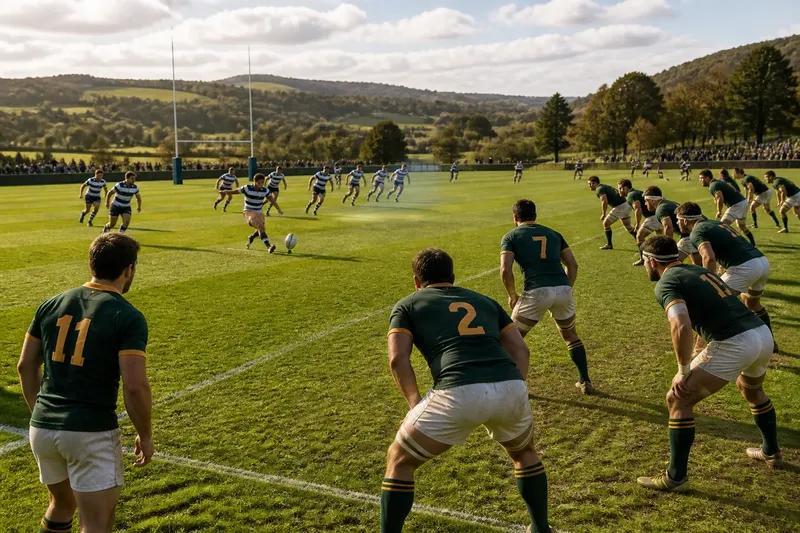
The referee signals after a score, and players begin arranging themselves around halfway. Rugby restarts are designed contests: the kick gives one side a chance to regain possession and the other a chance to receive and secure the ball. The formation before the kick offers clues about how each team hopes the next phase will begin.
Imagine an invented match between the Harbor Hawks and the Ridge Rovers. The Hawks have just scored, so the Rovers prepare to restart. The kick’s destination, the chasers’ timing, and the Rovers’ receiving shape will all matter, but the applicable law determines what each player may do.
Rugby restart laws
Under the standard laws of rugby union, the team that conceded a try restarts play with a drop-kick from halfway. After a successful penalty goal or drop goal, the scoring team restarts from halfway. In each case, the ball must meet the law’s requirements for the restart to be valid, including the required distance and where it must land or be played. The precise wording and any competition-specific variations should be checked in the current law book and competition rules.
Players on the kicking team must meet the required starting-position conditions, and opponents must respect the applicable restrictions as the kick is taken and contested. A restart is not a free-for-all: the laws govern both the kick and the players’ approach to a potential catch. For decisions during a match, the referee applies the current laws and competition regulations.
For the Harbor Hawks and Ridge Rovers, that means neither team can assume that any kick into the air is valid or that a chaser may approach the catcher without restriction. The Hawks must make a lawful kick and time their advance accordingly; the Rovers must receive and contest it within the same framework. This article describes the general structure, not a substitute for the current laws used in a particular competition.
Rugby restart formations
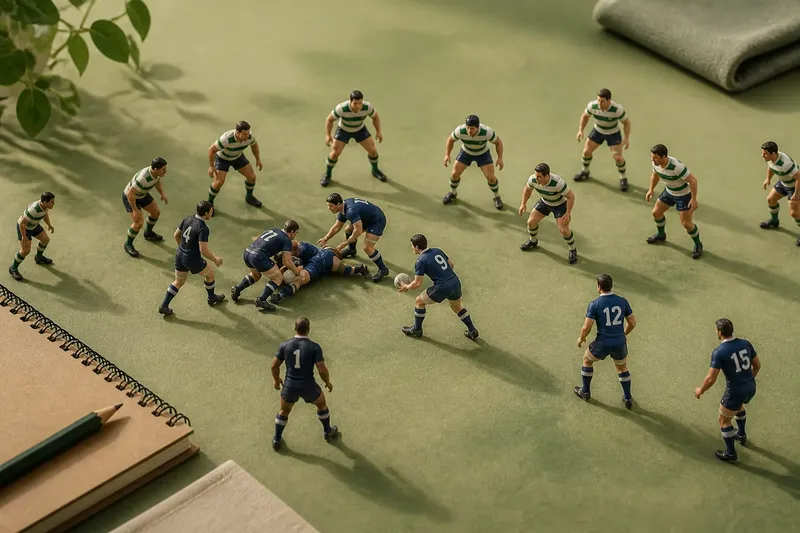
The receiving team usually positions players to cover likely landing areas, with nearby support ready to help secure possession. Other players may stay deeper to cover a kick beyond the first line. The shape is not fixed: it can change with the kicker’s approach, the wind, the score, and the team’s preferred way to start an attack.
The kicking team spreads its chasers to apply pressure across the field and aims to arrive as the ball descends. Teammates may prepare to contest, support a player who wins the ball, or defend against a return. The details depend on the team’s plan and the laws in force.
As a spectator, look at the space between the likely catcher and the approaching chasers. Nearby support may allow the receiver to secure the ball and make a short pass. If the landing area is crowded, the receiver may focus on catching and protecting possession. The formation suggests the first decision, though the bounce and pressure can change the plan.
Following the first phase
Suppose the Hawks aim a restart toward the right side of the Rovers’ formation. In this invented situation, the Rovers’ catcher takes the ball cleanly, and two teammates close in to support. A Hawks chaser arrives, but the Rovers retain possession. Because they have gathered near the touchline, they have less space to move sideways and must choose how to begin their attack.
The Rovers could carry the ball into contact, pass to a nearby support player, or kick it away. In this invented sequence, they pass behind the catcher to a teammate running inward, who is then tackled. The Rovers have started a phase, but the restart has shaped its location and the pressure they face.
Now consider a different invented outcome: the catcher loses control under pressure, and a Hawks player gathers the loose ball. The Hawks have possession, but still need to pass, carry, or kick while the Rovers organize their defense. The restart creates an opportunity, not an automatic score.
Restart questions?
Who restarts after a try?
In standard rugby union, the team that conceded the try takes the restart from halfway with a drop-kick. Check the current laws and competition rules for the match being played.
Can the kicking team regain possession?
Yes, the kicking team can contest the restart and may gain possession if the ball becomes available to it. The players must follow the laws governing the kick, their positions, and the contest.
What should a spectator watch first?
Notice where the kick is aimed, how the receiving team covers the likely landing area, and how the chasers approach. Then follow the first pass or carry to see how the restart shapes the opening phase.
Reading the contest
A restart gives the receiving team a chance to arrange around the likely landing area, while the kicking team has a planned route to apply pressure. Neither side controls the bounce or every movement that follows. A clean catch may lead to a settled attack; a loose ball may offer the opposition a chance to recover possession.
What is not worth the effort is trying to infer the entire play from one player’s position. Formations offer clues, not certainty, and teams can adapt once the kick is in the air.
For a clear view of rugby restarts, track the target, the support around the catcher, and the chasers’ approach, then watch the first phase. Those details reveal how the kick turns a score into a contest—and why the first decision after the catch matters.