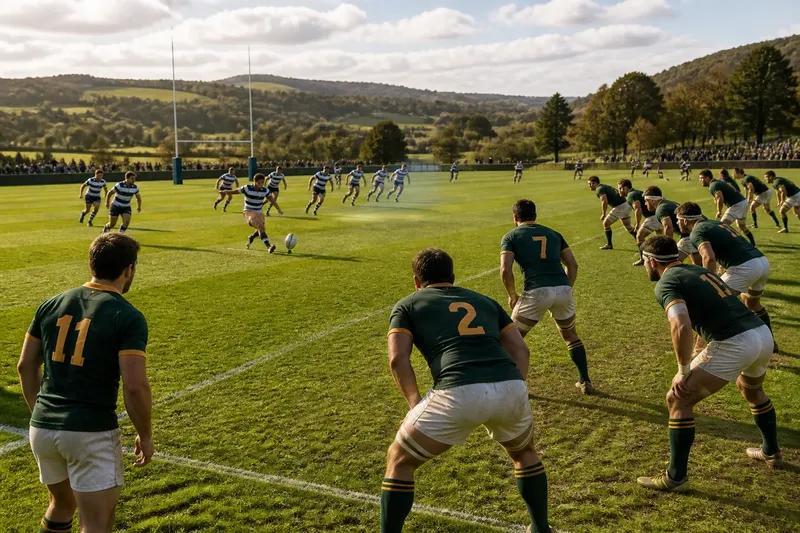
The Myth That Every Rugby Phase Should Go Forward
Rugby phases need not gain ground every time. Learn how to judge possession, support, and defensive shape so the next attack has a clearer option.
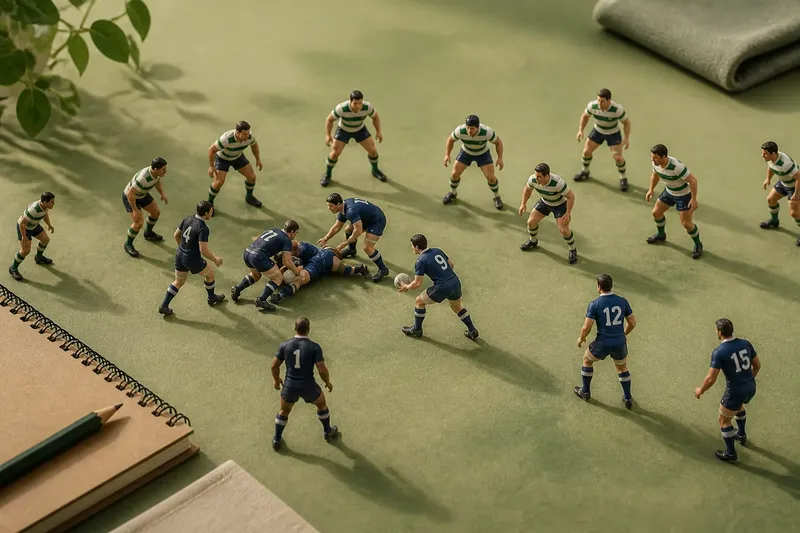
A carrier is stopped near the gain line, and the ball moves sideways to a teammate. That rugby phase may look unproductive, but it can still help the attack if the transfer keeps possession and gives the team a better choice next.
A phase is a passage of play from one breakdown contest to the next. Ground gained matters, but so do the ball’s security, the defenders’ shape, and the support available. A team that demands immediate progress on every carry can run into crowded space or leave the next phase harder to manage.
When ground disappears
Problem: The carrier runs at a set defensive line and is stopped close to where the attack began.
Usual cause: Defenders have had time to align and move together. A direct run may still draw defenders or create a useful contact, but repeating it against the same picture can leave teammates isolated.
Try: Judge the contact by what follows. If the carrier presents the ball cleanly and nearby support secures it, the phase may have done its job without a gain. The team can then shift to another channel or adjust its spacing before the next carry.
A pass across the field can make defenders move laterally, while a short transfer near the breakdown can help retain the ball and reset the attack. The useful question is whether the defense has been made to respond, not whether the ball crossed an invisible mark.
When support arrives late
Problem: A carrier goes to ground, but the next teammate arrives after defenders have begun contesting the ball.
Usual cause: The attack has organized around the carry rather than the possession that follows. Players farther out may be waiting for a pass, while no one is close enough to secure the breakdown. A planned gain can become a risky contest.
Try: Keep a small support group connected to the carrier while the rest of the team holds its width. Close players can protect possession; wider players preserve options if the ball is available. This balance avoids crowding the contact while giving the next phase somewhere to go.
Say an invented team has the ball near midfield and its carrier is met by two defenders. A nearby teammate arrives to secure the ball, while the outside players stay spread. The expected observable result is a cleaner choice for the next pass, even if the current phase gains no ground.
When the attack narrows
Problem: Several phases happen in the same small area, and each carry meets a dense group of defenders.
Usual cause: Players have followed the ball without restoring their positions. The attack still has possession, but its runners are bunched and the defense can focus on one lane. Another carry into that lane may spend effort without changing the picture.
Try: Use a phase to reorganize. Players can communicate, spread into distinct lanes, and identify whether the next opportunity is near the breakdown or farther out. A sideways pass or controlled carry can give teammates time to form a more usable attacking line.
This does not mean the ball should always go wide. A wide pass helps only if receivers have space and support; a central carry can still draw defenders. Choose from the shape that exists rather than automatically repeating the last action.
When a pass is forced
Problem: The ball moves quickly away from contact, but the receiver gets it under pressure or the pass goes loose.
Usual cause: The attack has mistaken motion for progress. A defense can slide with a pass, and a receiver without room or nearby support may be worse off than the original carrier. A secure phase can be more valuable than a rushed one.
Try: Check the receiver’s space, the defenders’ alignment, and the support around the ball. If the next pass has no clear target, keep possession and rebuild the picture. A short hold or safe carry can be better than sending the ball into a covered channel.
There is no need to make every phase elaborate. A simple carry that produces clean ball can be sound, as can a pass to an unmarked teammate. What is not worth the effort is inventing a complicated pattern merely to avoid a phase that makes little ground. The choice should fit the defense and the quality of the ball.
Rugby phases in practice?
What makes a phase successful?
A successful phase keeps the attack in control and leaves a reasonable next option. It may gain ground, draw defenders, improve support, or move the defense out of its preferred shape.
Should an attack always go wide?
No. Width can stretch a defense, but a pass toward the touchline may leave the receiver with little room. Move the ball wide when teammates are positioned to use that space, not simply because the previous carry stalled.
When should players reset their shape?
Reset when teammates have bunched, the likely channel is crowded, or support is too far from the contact. A brief adjustment can give the next phase clearer roles and more than one option.
Can a backward pass help?
Yes, if the pass is legal and controlled. It can give a teammate room to run onto the ball or let the attack change its angle without necessarily losing useful ground overall.
Choices before contact
Before a phase, players can check three things: whether the ball is secure, where defenders are concentrated, and whether teammates can support the likely choice. Those answers may point to a direct carry, a pass, or a moment to reform the attacking line. None is automatically best; each responds to the situation.
For a useful way to understand rugby phases, follow how the attack’s options change after contact rather than treating ground gained as the only measure. A sideways movement may have stretched the defense; a brief reset may have restored support. The next decision is clearer when players judge both what the phase achieved and what it left available.